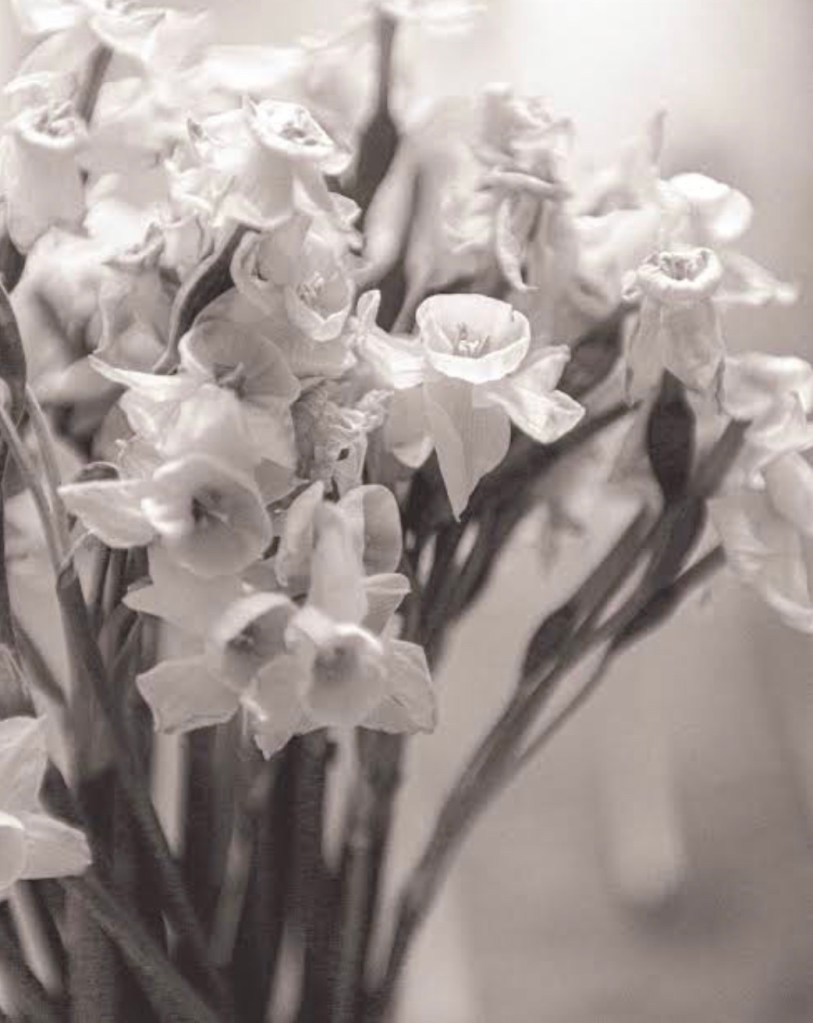
She carried a little bouquet
Of golden-hearted nargis*
Her face flushed, her eyes bright
She was going to make a gift of them
To someone special.
The bus stop was empty
Save the woman with the flowers
And me. I had my phone in my hand
She sat on the bench waiting
Clutching her bouquet
I stood nearby, holding my phone
Watching her secretly
Trying not to spook her
But she was mesmerizing
In the tender enchantment
That surrounded her

The bus was late
She sat there almost motionlessly, quietly
But the thrum of her joyful energy
Was taken up by the gay bouquet
As it danced gently in the breeze
She wore yellow shalwar kameez*
With little white flowers
Or were they stars?
They were tiny, almost imperceptible
So small I was sure even she wouldn’t know
But they shimmered in her gaiety
She smiled as she adjusted the stems
The flowers bobbed back happily
She sat there like a painting
Full of joy and anticipation

The bus rolled in
Carrying its load of passengers
I lingered a while to see
The recipient of this picture of love
That waited brightly on the seat
Together we watched people alight
People go left and right
Until the last passenger stepped down
I climbed on, slowly, hesitantly
I sat down near a window and looked out
The bouquet now lay inertly on the bench
Its sunny heart wrenched
Where it had been clenched
In the ardent embrace of a pair of hands
Drenching it in the liquid warmth of love

They were stars, not flowers
On her kameez, five-pronged tridents
Piercing, lancing, shattering
The perfection of beautiful things
Hidden, Unbeknownst to her
The fault, I was sure, lay in the stars.
* Nargis: Daffodil

* Shalwar kameez: the long shirt and trousers worn by women in Pakistan and India
A haiku is an unrhymed Japanese poetic form that consists of 17 syllables arranged in three lines containing five, seven, and five syllables, respectively. A haiku expresses much and suggests more in the fewest possible words. Trying my hand at the lithe and sinewy art form.
Some gladness, some strife
Mixed in with some love and hope
Faultless slice of life.


It opens again
Haltingly, poundingly, my
Newly love-drenched heart.


The light shone, my soul
Soared. The monitor too glowed
In final farewell.


The pane shudders, shakes
In the wind. The pelting rain
Renews, whets the pain.


The old men sit snug
In their fortressed halls waiting
Out the raging storm.


She lay down to rest
The crickets were still. There were
None six feet under.


The breeze kissed my face
Whispering, praying we would
Never meet again.


Tea with buttered toast
A little sip, a bite, my
Broken heart revived.


The wind pulled at him
The kite pulled at his laughter
Heart in hand they soared.
The morning glow touched its face
The brick-faced house in the street
It stretched out in the morning rays
Hide’n’seek with some it played
Its favourite morning treat

In the bedroom facing the east
I lay in sleep’s placid arms
The sun wore its morning beam
As it shone into my dawn time dreams
Oblivious of my late alarm

The house shook out its paint and bricks
Its nooks and crannies too
The mynah was already collecting twigs
To fix its nest, repair the rips
From last night’s stormy brew

The day wore on, the house filled up
With daytime smells and sounds
It shook and shimmered, belched and laughed
As it held us all in its matronly arms
Safe in its blessed compound

Evening came and with it the skies
Turned a beautiful rosy pink
T-41 too flushed with delight
Its terracotta facade catching the light
As it watched the twilight sink

The resident crickets began to perform
Their night time symphony
The house sighed softly gathering its form
It seemed like tonight would bring another storm
But inside its walls was warmth and sleep.
It was two for tea and tea for two
Both meeting after a decade or two
Friends of old, kins of the heart
Separated by time and circumstance
Chatter and laugh over tea for two

Tea for two and two for tea
Neighbours for a year, kindred souls for twenty-three
They’d seen each other through thick and thin
Loving Kintsugi* mending walls where they’d grown thin
Catch up over two for tea

It was two for tea and tea for two
From working together their friendship grew
They had rejoiced in one another’s highs
Had held each other’s hands in trying times
Rendezvous over tea for two

Tea for two and two for tea
The sister and the brother sit quietly
The coolness of bruised hearts lies around
The air is rent with empty sounds
As they try to build bridges over two for tea

It is usually two for tea and tea for two
That brings hearts together, both the sunny and the blue
Loving ones forge ever joyful memories
Aching ones for a while find some peace
When they come together over tea for two.
* Kintsugi: The Japanese art of putting broken pottery pieces back together with gold — built on the idea that in embracing flaws and imperfections, you can create an even stronger, more beautiful piece of art.









 Mahvash Mohtadullah